When shopping for a premium mattress, the sheer volume of technical terminology can be overwhelming. Phrases like “orthopedic support” and “spinal alignment” are thrown around constantly, but the actual performance of a mattress comes down to the science of its underlying foam chemistry.
Among the high-end material options available today, two core technologies dominate the market: Memory Foam and High-Recovery (HR) Foam. Both promise to eliminate morning backaches and maximize sleep quality, but they manipulate pressure and kinetic energy in entirely different ways.
If you are trying to upgrade your sleep setup and want to know which material truly wins the battle for spinal health, here is an objective, third-party technical breakdown of how these foams operate, where they excel, and how they compare under real-world conditions.
Understanding the Contenders: Material Physics
To evaluate their impact on your spine, we must first look at how these two materials are structurally engineered.
1. Memory Foam (Visco-Elastic Polyurethane)
Originally developed by NASA, memory foam is a highly temperature-sensitive material. When you lie down, your body heat and physical weight cause the foam to soften, allowing it to slowly stretch and conform precisely to your body shape.
- The Sensation: It delivers a deep, contouring “hug.”
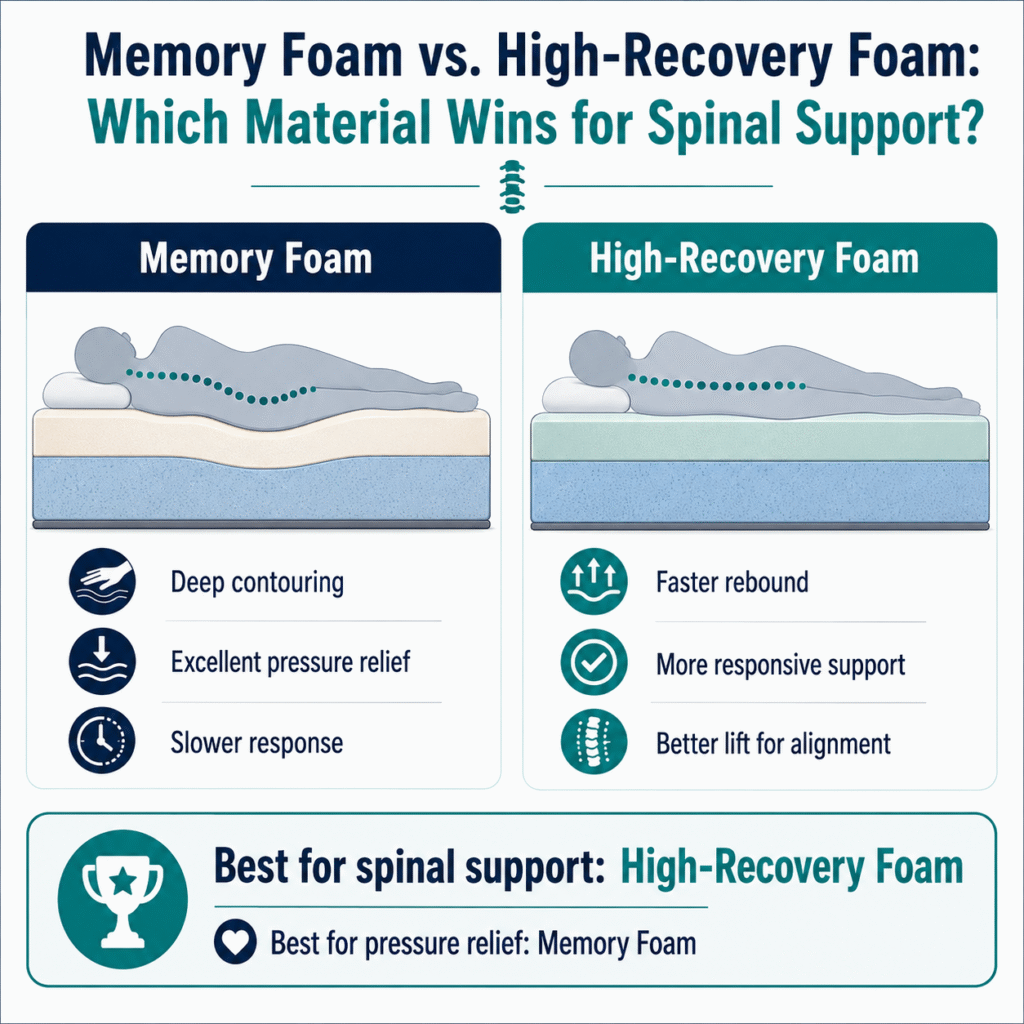
- Mechanical Action: It excels at absorbing impact and pressure, sinking beneath heavy areas like your shoulders and hips to distribute body weight evenly across the entire surface.
2. High-Recovery Foam (High-Resilience HR Polyurethane)
High-Recovery foam is engineered with an irregular, open-cell structure that acts like thousands of microscopic shock absorbers. Unlike memory foam, which responds to temperature and takes time to shift, HR foam reacts purely to physical pressure and responds instantly.
- The Sensation: It provides a balanced, “buoyant” lift that keeps you on top of the bed.
- Mechanical Action: The moment weight is applied, the cells compress; the moment you shift, they immediately bounce back to their original state, providing continuous upward resistance.
The Spinal Support Showdown
Spinal alignment relies on keeping your ears, shoulders, lumbar region, and hips in a straight line, regardless of whether you sleep on your back, side, or stomach. Here is how both materials perform across critical support metrics:
1. Pressure Point Relief
- Memory Foam: By contouring closely around sharp bodily angles, it can reduce surface pressure on delicate zones by up to 80%. This makes it exceptional for preventing numbness and tossing and turning.
- High-Recovery Foam: It distributes weight effectively but pushes back against the body rather than melting away. It offers excellent macro-support across broader surface areas.
2. Postural Stability & Sag Resistance
- Memory Foam: Because it softens with heat, heavy zones like the hips can occasionally sink a bit too deep over long hours of sleep. If the underlying support core isn’t robust, this can pull the lumbar spine out of its natural alignment.
- High-Recovery Foam: This is where HR foam shines. Its high cell density provides a balanced, medium-firm resistance that prevents deep sagging. It fills the gaps around your lower back while maintaining a stable, unyielding foundation that keeps your spine perfectly straight.
3. Ease of Movement
- Memory Foam: Due to its slow response time, moving or changing positions requires slightly more effort, creating a temporary “stuck” feeling.
- High-Recovery Foam: Its instant spring-back capability mirrors your movements seamlessly, allowing you to roll over smoothly without disrupting your sleep cycle.
Evaluating Market Benchmarks in Pakistan
As the Pakistani bedding market transitions toward specialized sleep health tech, local manufacturing standards have evolved to offer both configurations. When analyzing how these materials are utilized commercially, looking at flagship product lines reveals distinct design intents:
- The Memory Foam Benchmark: Consumers looking for maximum contouring often turn to premium visco-elastic designs. A prominent example is the Supreme Memory Mattress by Diamond Supreme Foam. By incorporating imported, high-density memory foam, this configuration targets localized pressure relief, actively molding to body heat to neutralize shoulder and hip stress.
- The High-Recovery Benchmark: For sleepers who prefer stability and a lift that prevents sagging over generations, manufacturers rely heavily on engineered HR bases. This architecture is highlighted in the flagship Diamond Supreme Foam Mattress series. Recently re-engineered with advanced High-Recovery foam technology, it focuses on providing a 10-zone balanced profile, ensuring the hips are kept level with the rest of the torso to avoid long-term postural fatigue.
- Other Market Options: Brands like Celeste offer various luxury hybrid and pocket-spring configurations that weave these foam styles into multi-layered mattresses, targeting similar spinal alignment goals.
Comparison Matrix: Performance Dynamics
| Feature / Metric | Memory Foam Tiers | High-Recovery (HR) Foam Tiers |
| Primary Support Method | Temperature-sensitive contouring | Active, high-density vertical lift |
| Spinal Alignment Profile | Deep cradling (Molds to curves) | Balanced, sag-free alignment |
| Response Time | Slow (Delayed recovery) | Instantaneous rebound |
| Airflow & Temperature | Can retain heat if unventilated | Highly breathable open-cell matrix |
| Ideal For | Side sleepers & pressure pain relief | Back/stomach sleepers & orthopedic care |
The Verdict: Which Material Wins?
Neither material is objectively superior; instead, the “winner” depends entirely on your specific physical needs and sleep posture:
- Choose Memory Foam if your primary struggles are morning shoulder pain, hip soreness, or poor blood circulation that leads to constant tossing and turning.
- Choose High-Recovery Foam if you suffer from chronic lower back pain, require a firmer orthopedic alignment, or dislike the sinking sensation of traditional foam. Its ability to provide deep, sag-free support makes HR foam the highly practical choice for maintaining long-term, structurally sound spinal health.
Frequently Asked Questions (FAQs)
Q1: Can a mattress combine both Memory Foam and High-Recovery Foam?
Yes. Many high-end hybrid mattresses use a multi-layered design to offer the best of both worlds. They feature a plush top layer of memory foam for immediate pressure relief, backed by a thick, heavy-duty base of high-recovery foam to prevent the body from sinking too deep.
Q2: How does Pakistan’s hot climate affect these foams?
Because memory foam reacts to temperature, intense summer heat can cause it to feel slightly softer than it would in a cooled environment. High-Recovery foam relies entirely on physical weight rather than temperature, meaning its firmness and structural support remain perfectly consistent regardless of seasonal weather swings.
Q3: How often should a high-density foam mattress be replaced?
Low-density utility foams fail within a few years, but premium high-density variants are built for long-term durability. Market-leading options backed by advanced manufacturing setups—such as the specialized foam ranges from Diamond Supreme Foam, come with a hassle free 12-year warranty, indicating the core will maintain its resilience for over a decade.