Finding the best foam for a mattress in 2026 means navigating a sea of advanced materials and evolving sleep science. Whether you are dealing with chronic morning back pain or restless nights due to overheating, the “core” of the problem, and the solution, usually lies in the foam chemistry.
Choosing the right mattress foam is essential for restorative sleep, targeted pressure point relief, and long-term durability. To simplify your search, we’ve broken down the most popular foams of the year, exploring the pros and cons of each to help you find your perfect ergonomic match.
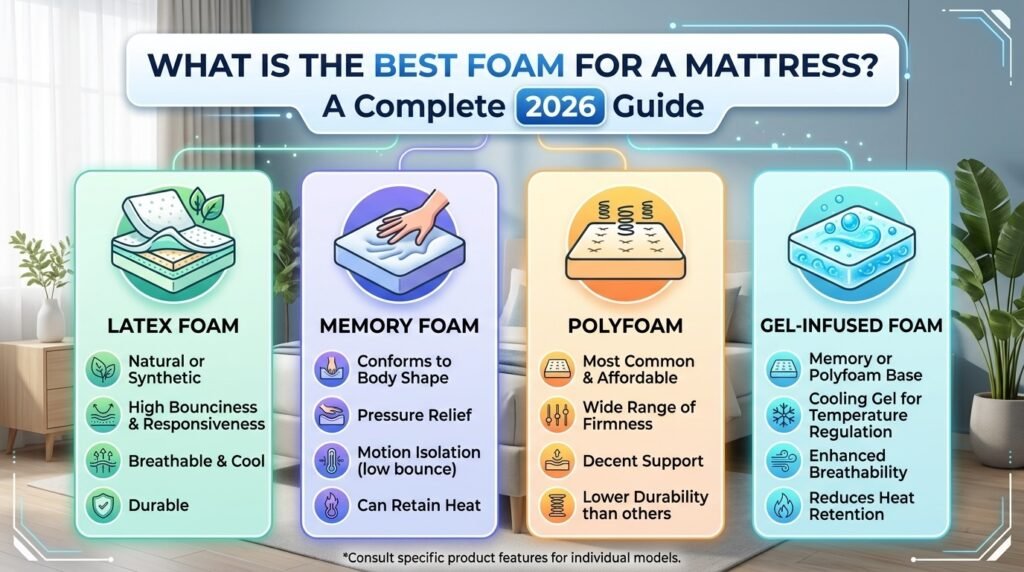
1. Natural & Synthetic Latex Foam
Latex remains a premium contender in 2026, known for its signature “buoyant” feel and eco-friendly origins. Natural latex is harvested from rubber tree sap (often GOLS-certified), while synthetic versions are engineered for a more consistent, budget-friendly density.
Benefits of Latex:
- Exceptional Durability: These mattresses are an investment, often lasting 10 to 15 years with minimal sagging.
- Responsive Support: Unlike memory foam, latex provides an immediate “push-back,” ensuring optimal spinal alignment for all sleeping positions.
- Natural Cooling: The open-cell structure is inherently breathable, outperforming traditional foams in heat dissipation.
- Hypoallergenic Properties: Naturally resistant to dust mites, mold, and mildew—ideal for sensitive sleepers.
Drawbacks:
- Price Point: High-quality natural latex typically commands a premium price.
- Weight: These slabs are heavy and can be difficult to rotate or move.
- Firmness: The high response rate may feel too “stiff” for petite side sleepers.
Best For: Sleepers seeking eco-friendly materials, maximum longevity, and a buoyant, “on-top-of-the-bed” sensation.
Read More: Best Mattresses For Side Sleepers
2. Memory Foam (Viscoelastic Polyurethane)
Viscoelastic polyurethane, or memory foam, remains the gold standard for body contouring. It uses sophisticated polymer chains that react to body heat to mold to your exact silhouette, providing a “cradled” sensation.
Benefits of Memory Foam:
- Deep Pressure Relief: By distributing body weight evenly, it significantly reduces stress on shoulders, hips, and lower back joints.
- Superior Motion Isolation: This is the ultimate choice for couples; it absorbs kinetic energy to minimize disturbance from a partner’s movements.
- Customized Density: Available in various ILD (Indentation Load Deflection) ratings to suit every weight profile.
Drawbacks:
- Heat Retention: Traditional viscoelastic structures can trap heat (though 2026 models often combat this with open-cell tech).
- The “Stuck” Feeling: Lower-density foams may have a slow recovery time, making it harder to change positions.
Best For: Side sleepers, individuals with joint pain, and those who prefer a deep, “hugging” comfort.
3. Gel-Infused “Gel-Cool” Foam
As a direct evolution of traditional comfort layers, Gel-Infused foam incorporates liquid gel beads or phase-change swirls to combat the thermal mass issues common in older mattresses.
Benefits of Gel-Infused Foam:
- Advanced Temperature Regulation: The gel acts as a thermal conductor, wicking excess heat away from the skin.
- Hybrid Comfort: You get the pressure-relieving benefits of memory foam without the uncomfortable “hot spots.”
- Motion Dampening: Like standard memory foam, it excels at deadening movement across the bed surface.
Drawbacks:
- Premium Cost: Usually carries a higher price tag than standard polyfoam.
- Durability Concerns: Low-quality gel infusions can occasionally break down faster than solid high-density foam.
Best For: Hot sleepers and combination sleepers who need pressure relief but struggle with night sweats.
Read More: Beyond the Basics: Essential Accessories for a Luxurious Bed
4. Polyurethane Foam (Polyfoam)
Polyfoam is the most versatile material in the industry. While it serves as the high-density base for luxury hybrids, it is also the primary material for the affordable bed-in-a-box market.
Benefits of Polyurethane Foam:
- Budget-Friendly: The most cost-effective entry point for a new mattress.
- Lightweight Design: Easy to compress, ship, and rotate.
- Immediate Availability: Found in most guest room mattresses and temporary sleep solutions.
Drawbacks:
- Lower Lifespan: Low-density polyfoam is prone to “body impressions” and may sag within 3 to 5 years.
- Limited Contouring: It lacks the sophisticated “melting” feel of memory foam or the bounce of latex.
Best For: Guest rooms, budget-conscious shoppers, or those needing a lightweight, temporary bedding solution.
2026 Comparison Table: Foam Types at a Glance
| Feature | Latex Foam | Memory Foam | Gel-Infused Foam | Polyfoam |
| Technical Material | Natural/Synthetic Rubber | Viscoelastic Poly | Gel-Infused Visco | Standard Polyurethane |
| Tactile Feel | Buoyant & Responsive | Contouring/Hugging | Cool & Contouring | Varies/Standard |
| Pressure Relief | Good | Excellent | Excellent | Moderate |
| Motion Isolation | Moderate | Excellent | Excellent | Moderate |
| Cooling Profile | High (Breathable) | Low to Moderate | High (Heat-Wicking) | Variable |
| Durability | 10–15+ Years | 7–10 Years | 7–10 Years | 3–7 Years |
| Ideal User | Eco-Buyers/Hot Sleepers | Side Sleepers/Joint Pain | Hot/Combo Sleepers | Budget/Guest Beds |
How to Choose the Best Foam in 2026
Before making your final choice, evaluate these four critical pillars of sleep health:
- Sleeping Position: Side sleepers require the “give” of memory or gel foam to protect the shoulders. Back and stomach sleepers need the firm “push-back” of latex to prevent spinal bowing.
- Thermal Comfort: If you wake up clammy, prioritize Gel-Cool technology or Natural Latex. Avoid traditional, non-ventilated memory foam.
- Investment vs. Price: While polyfoam is cheaper today, high-density memory foam and latex offer a superior cost-per-year value due to their resilience.
- Allergy Profiles: If you struggle with asthma, natural latex is the cleanest, most dust-mite-resistant option on the market in 2026.
Conclusion
There is no single “best” foam, only the best foam for your unique body type and sleep environment. If you value longevity and organic materials, Latex is the clear winner. If you need deep relief for aching joints, Memory Foam or Gel-Infused Foam is the superior choice. For a guest room or a tight budget, Polyfoam remains a reliable, accessible staple.
Ultimately, the right foam is the one that achieves neutral spinal alignment and allows you to wake up feeling recharged.
FAQs
1. Is memory foam better than latex for back pain?
Memory foam is excellent for localized pressure relief. However, for chronic lower back pain, latex often provides better support by keeping the spine in a neutral position rather than allowing the hips to sink too deep.
2. How long does a gel-infused foam mattress last?
Typically 7 to 10 years. To maximize lifespan, ensure you choose a high-density gel foam and rotate the mattress every 6 months to prevent localized wear.
3. Can polyfoam mattresses be comfortable?
Absolutely, especially when used as a transition layer in luxury hybrids. For a primary bed, look for “High-Density” (HD) polyfoam to ensure comfort that lasts beyond the first year.
4. Are latex mattresses suitable for hot sleepers?
Yes. Natural latex is widely considered the most breathable foam available, making it the top recommendation for those who live in warmer climates or experience night sweats.